
The need to stay connected quickly and easily has led to smartphones becoming much more than just phones.
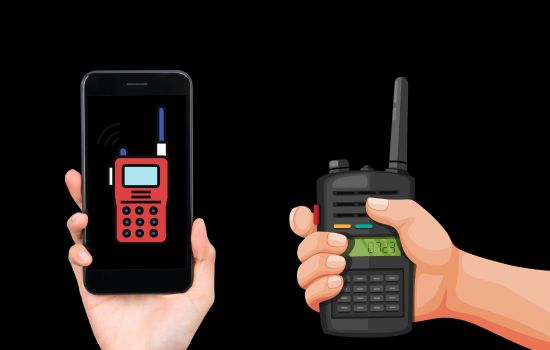
Nowadays, thanks to specialized applications, it is possible transform your cell phone into a real walkie talkie which works over Wi-Fi and mobile networks.
In this text, you will discover why having an extra communication channel is essential, you will learn the benefits of using PTT (Push-to-Talk) apps, you will explore the functionalities of Zello Talkie and CB Walkie Talkie.
Why you need an alternative communication method
- Environments with limited coverage
In rural areas, industrial plants or interiors of large buildings, mobile telephone networks may have signal gaps. A virtual walkie talkie keeps the conversation active thanks to its adaptability to different types of connections. - Network saturation in emergencies
During natural disasters or mass events, telecommunications infrastructure collapses. PTT technology, by using low-bandwidth data, reduces congestion and allows messages to be sent even when conventional calls fail. - Coordination in real time
Unlike text messaging or email, a Push-to-Talk system offers instant transmission: You press a button and your voice message arrives instantly, without waiting for the recipient to pick up or accept the call. - Simplicity of use for everyone
No advanced technical knowledge or complex configurations are required. A pseudonym or minimal registration is enough to initiate communication. - Saving resources
Instead of investing in high-frequency radios or special licenses, many PTT applications offer free or low-cost versions, taking advantage of hardware you already own: your smartphone.
See also
- Release your Talent: Learn Guitar at Home without Spending
- Shine with Confidence: Your Cell Phone as a Real Jewelry Detector
- Master Your Digital Presence: How to Know Who Visits Your Networks
- Explore the Subsoil with your Mobile: How to Detect Metals and Gold
- Top 5 Innovative Foods to Master Your Glucose Control
Advantages of walkie talkie applications in your routine
- Group connections: Creates “channels” of voice where several users can listen and speak simultaneously, ideal for work teams, excursions or large families.
- Low data consumption: One hour of Push-to-Talk conversation can consume as little as 5.10 MB, compared to hundreds that may require traditional VoIP calls.
- Message history: Many services save communications for later review, which is invaluable if someone was unable to connect in real time.
- Alerts and priorities: Set up custom notifications to distinguish urgent messages from less critical ones.
- Cross-platform compatibility: In addition to mobile, you can use the desktop version or even dedicated devices that emulate handheld radios.
- Encryption and security: Some solutions offer end-to-end encryption, protecting the privacy of your information.
- Geographic flexibility: Communicate with people anywhere in the world as if they were by your side, as long as they have an internet connection.
Zello Talkie: power and professionalism at your fingertips
Zello Talkie it is one of the most established PTT apps, chosen by individual users and companies alike. Its highlights:
- Unlimited channels: Publish and join open or private channels without restriction of participants.
- Optimized audio quality: Adjusts transmission to deliver clear voice even with weak signal connections.
- Queued messages: If you're not available when someone speaks, Zello stores the message and delivers it to you when you reconnect.
- Media files: Share additional images and text messages, enriching communication.
- Integration with hardware: EPOS devices or Bluetooth buttons can be activated as an external PTT, simulating a professional walkie talkie.
- Business control: With Zello for Work you get administration panels, real-time location mapping and usage reports.
- Cross-platform support: Available on Android, iOS, Windows, Linux and dedicated computer versions.
How to get started with Zello Talkie?
- Download the app from Google Play or App Store.
- Sign up with your email or phone number.
- Search for public channels of interest or create a new one.
- Assign access permissions and operator roles if you manage a computer.
- Press the PTT icon when you need to talk; release it to listen.
CB Walkie Talkie: the direct and hassle-free option
For those looking for maximum simplicity, CB Walkie Talkie offers an experience “plug and plays”:
- No extended records: You just choose an alias and enter the channel.
- Preconfigured channels: Select from categories such as “emergencias”, “aventur” or “social” to join instantly.
- Offline operation: Some versions allow communication via Bluetooth or Wi-Fi Direct peer-to-peer without the need for internet.
- Minimalist interface: A great PTT button and active user list; that's all you need.
- Power saving mode: Works effectively in the background without quickly draining your battery.
- Discreet ads: The free version barely interrupts with advertising; the premium option removes it completely.
Quick steps to use CB Walkie Talkie
- Install the app and assign your nickname.
- Choose the desired channel from the predefined list.
- Press “Talk” to transmit and “Listen” to receive messages.
- Take advantage of Bluetooth mode if you are in an area without an internet connection.
From radio waves to the smartphone: brief history of the walkie talkie
- 1930s: Canadian engineer Donald Hings develops the “packset”, a device weighing about 10 kg that allowed two-way communication for rangers and rescuers.
- World War II: Motorola introduces the SCR-300, known as the first true military walkie talkie, used by Allied troops to coordinate movements on the front.
- Hands-free 1942: He appears SCR-536, a smaller handheld equipment, popularizing the term “handie-talkie”.
- It was commercial: In the 50s and 60s, civil use emerged for fire departments, police and rescue organizations.
- Digital transition: With the emergence of GSM and CDMA networks, portable radios evolve into digital systems with better quality and less interference.
- Smartphone revolution: In the mid-2010s, the deployment of 4G/5G and high-speed mobile internet allowed PTT applications to replace many of the dedicated devices, offering an alternative accessible through any cell phone.
Conclusion
The ability to turn your cell phone into a walkie talkie it provides you with an additional layer of security and communication efficiency, essential in emergencies, professional environments or recreational activities. The applications Zello Talkie and CB Walkie Talkie they show that you don't need extra hardware or million-dollar investments to enjoy high-quality Push-to-Talk communication. From the bulky military equipment of World War II to today's mobile apps, the spirit of the walkie talkie lives on: speak and listen instantly, hassle-free. Integrate these tools into your routine and discover how a touch of your finger can keep you connected wherever you are.