Fundamentals of football
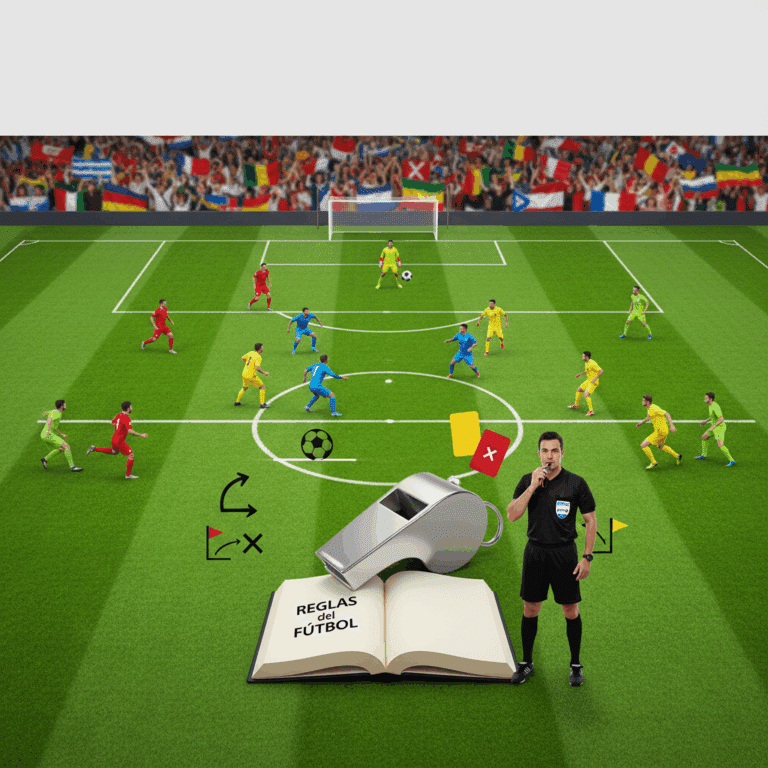
Soccer is a dynamic sport played between two teams of eleven players on a rectangular field. Its popularity lies in its simplicity and clear rules that guarantee equity.
The main objective is to score more goals than the opponent, introducing the ball completely into the rival goal, always respecting the rules established for a fair and fair game.
Characteristics of the field and objectives of the game
The soccer field measures between 90 and 120 meters long and between 45 and 90 meters wide. It is delimited by lines that indicate the playing area and the goal at each end.
The ball must completely cross the goal line to validate it somewhat, and throughout the match the aim is to reach the greatest number of goals without committing infractions.
Only the goalkeeper can touch the ball with his hands inside his own area, while the other players use their feet and other parts of their body to control and advance the ball.
Composition and roles of the players
Each team is made up of eleven players with specific roles: goalkeeper, defenders, midfielders and forwards. Each one has functions to defend or attack according to the tactical plan.
The goalkeeper protects the goal and is the only one authorized to use his hands in his area. Defenders prevent rival advances, while midfielders and forwards generate scoring opportunities.
Understanding these roles is key to coordinating the team and executing strategies that allow controlling the game and effectively overcoming the opposing defense.
Basic rules of the game
Football has rules that ensure fair and orderly development. These rules define how the match begins and ends, ball handling and permitted actions.
Knowing these rules is essential for players and spectators, as they guarantee respect between teams and the correct application of the regulations during the game.
Start and duration of the match
The match begins with a serve from the center of the field after tossing a coin to decide which team starts with the ball or the side of the field.
The game consists of two halves of 45 minutes each, separated by a break, allowing the teams to prepare for the second half.
Time can be extended if there are interruptions, to ensure that effective time is played and competitiveness is maintained during the match.
Use of the ball and handling prohibited
Only the goalkeeper can touch the ball with his hands and only within his area. Any other manual use by players is considered a foul and sanctioned.
The ball remains in play as long as it does not completely cross the lines of the field or any infraction is reported that stops the game.
Ball control is carried out mainly with the feet, head and other parts of the body, avoiding handling the ball illegally.
Fouls, penalties and free throws
Fouls occur when performing unsportsmanlike actions such as pushing, holding, or kicking an opponent, which can cause immediate consequences in the game.
When a foul is committed, the opposing team receives a free kick from the place of the infraction, and if it occurs inside the area, a penalty is awarded.
These sanctions seek to protect the integrity of the players and maintain fair play, penalizing conduct contrary to the rules.
Offside rule
The offside rule prevents an offensive player from placing himself too close to the opponent's goal without at least two defenders between him and the goal when receiving a pass.
This rule avoids unfair advantages and promotes strategic play, encouraging coordinated movement and tactical planning between teams.
The referee is the one who decides if a player is offside, stopping the play and granting a free kick to the opposing team if necessary.
Goal scoring and validity conditions
Scoring a goal is the fundamental objective of football, where the ball must completely cross the goal line between the posts and under the crossbar.
The validity of the goal depends on strictly complying with the rules, avoiding previous infractions that could invalidate the score.
Understanding these criteria allows players and fans to recognize when something is legitimate and when it is not.
Criteria to validate a goal
A goal is valid only if the ball crosses the goal line completely, without there being any foul or infraction committed by the scoring team in the play.
If the ball touches any part of the post or crossbar without passing completely, no goal is awarded; Furthermore, if a player is offside or commits a foul, the score is annulled.
The referee, assisted by linesmen or official technology, verifies that all conditions are respected before validating a goal.
In controversial situations, tools such as VAR help corroborate whether the ball completely crossed the line and whether the play was completely legal.
Additional techniques and regulations
Basic techniques are essential for beginners to improve their performance and understand the collective game in football.
In addition to technique, regulations on substitutions and suspension guarantee fluidity and safety during matches.
Basic techniques for beginners
To begin with, mastery of the pass is essential. You learn to pass the ball precisely using the inside of your foot, facilitating possession and construction of plays.
Control of the ball is also vital. Using different parts of the body allows you to receive and handle the ball without losing it under pressure from the opponent.
Finally, dribbling helps overcome opponents through quick movements and changes of direction, creating attacking opportunities for the team.
Substitutions and suspension of the party
Each team can make up to five substitutions in a match, allowing for renewed energy and adjusted tactics during the game.
Substitutions are made at permitted times so as not to interrupt the flow of the match and must be authorized by the referee.
If a team is left with fewer than seven players due to expulsions or injuries, the referee must suspend the match to avoid imbalance.