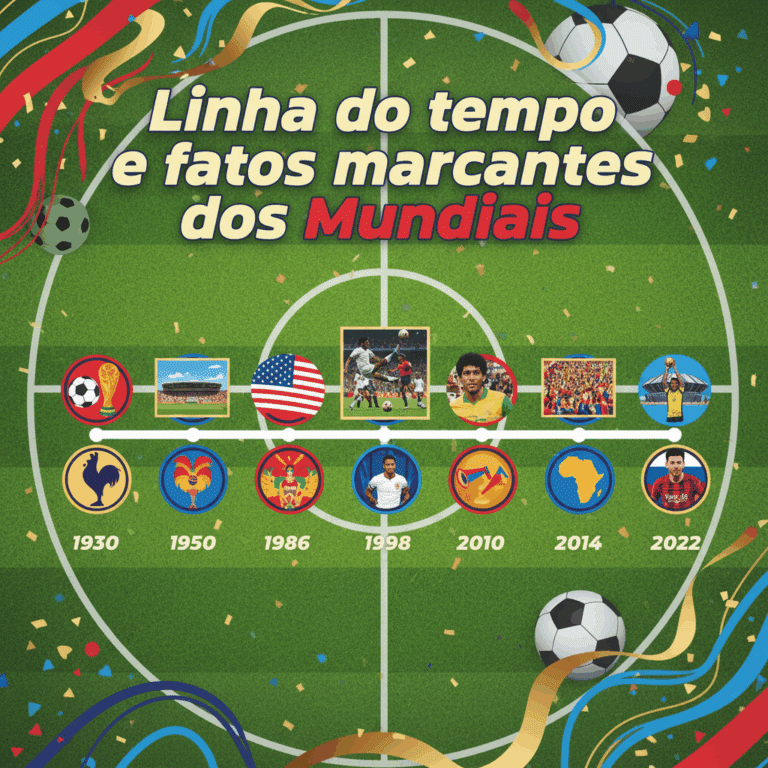
Initial timeline of the World Cup
The FIFA World Cup it began in 1930 in Uruguay, where the host country became champion after beating Argentina. This event marked a milestone in international football.
The tournament is traditionally held every four years, but was interrupted in 1942 and 1946 due to the World War II. The Cup resumed its activity in 1950, consolidating itself as the largest football competition.
Origins and first editions (1930-1946)
The World Cup began in Uruguay with 13 teams. Italy was a pioneer by organizing the Cup in Europe in 1934, also winning it. The Italian team repeated the title in 1938, becoming the first two-time champion.
These first editions were marked by strong contexts sociopolitical, highlighting the Mussolini regime in Italy that used the tournament for propaganda purposes.
Restart and notable events after World War II
After the war lull, the World Cup returned in 1950 with Brazil as host. That tournament is remembered for the historic “Maracanazo”, when Uruguay surprised by defeating Brazil in the unprecedented final.
This event symbolized a moment of great social and sporting impact, consolidating the Cup as a phenomenon of global reach and popular emotion in each edition.
Evolution and expansion of the tournament
As the years went by, the World Cup it has experienced significant growth, both in the number of participating teams and in its global reach.
This growth has allowed the inclusion of new regions and the consolidation of competition as the most important sporting event worldwide.
Growth in number of teams and global reach
Initially with 13 teams, the World Cup expanded to reach 32 teams in 1998, thus reflecting the growing popularity of international football.
This expansion allowed the participation of countries from Africa, Asia and Oceania, expanding the cultural and competitive diversity of the tournament.
Furthermore, holding editions on different continents helped the World Cup conquer new audiences and increase its media impact.
Dominance of Brazil and other historical champions
Brazil emerged as a world power, obtaining five titles, including the 1958, 1962 and 1970 editions, with legendary figures such as Pelé.
Italy and Germany also stood out by winning several championships, being historical references that contributed to the prestige of the tournament.
Argentina, with victories in 1978 and 1986, reaffirmed a football tradition that positions it among the greatest powers in the world.
Sociopolitical impact in World Cup editions
The World Cup has reflected complex political contexts in several editions, such as the influence of the fascist regime in Italy or the dictatorship in Argentina during 1978.
In addition, the tournament has served as a platform for social demonstrations and moments of national unity, demonstrating its importance beyond sport.
Fun fact
The “Maracanazoc” of 1950 not only had a sporting impact, but also sparked a deep social and political debate in Brazil, transforming the perception of football in that country.
Iconic moments and legendary players
The history of the World Cup is full of unforgettable moments that have marked millions of fans. These highlights often combine intense emotions with sporting prowess.
Legendary players not only left their mark for their skills, but also for iconic actions that changed the course of matches and entire editions.
Emblematic incidents: “Maracanazocomps and gestures of Maradona
The 1950 “Maracanazoc” is one of the most dramatic events in world football. Uruguay beat Brazil at the Maracaná, causing deep surprise and sadness in the host country.
Diego Maradona is another central figure, famous for his “Mano de Dios” and the “Gol del Sigloc” against England in 1986, moments that symbolize genius and controversy.
These events have become symbols of the tournament, representing both the glory and unpredictability of the World Cup.
Memorable goals and plays in World Cup history
Among the notable goals is Manuel Negrete's impressive scissor goal in 1986, which is still remembered for its technique and aesthetic beauty.
Recent finals, such as 2014, offered intense emotions with decisive goals in overtime, such as Mario Götze's for Germany.
These plays not only define championships but also inspire generations of players and fans around the world.
Cultural meaning and legacy of the World Cup
The World Cup transcends sport and becomes a cultural phenomenon that unites various societies under the common passion for football. Its social impact is profound and lasting.
This global tournament fosters national identity and offers countries a global platform to showcase their culture, traditions and collective pride, creating an indelible legacy.
Social and cultural influence of the tournament
The World Cup generates a feeling of unity and hope among nations, showing how sport can overcome social and political barriers to connect people.
Furthermore, its historical moments become cultural symbols that feed the popular imagination and the collective memory of many generations.
The event also promotes social changes, such as the promotion of inclusion and equality, reflecting the evolution of values in different societies.
Inspiration for generations of footballers
The exploits and examples of great players at the World Cup inspire thousands of young people to pursue their dreams in football, fostering new generations of talent.
The World Cup represents a dream goal for footballers, demonstrating that with effort and dedication it is possible to achieve glory and leave an indelible mark.
This tournament is a constant source of motivation that drives clubs, academies and national teams to develop the potential of their future athletes.