Tactical training in professional football
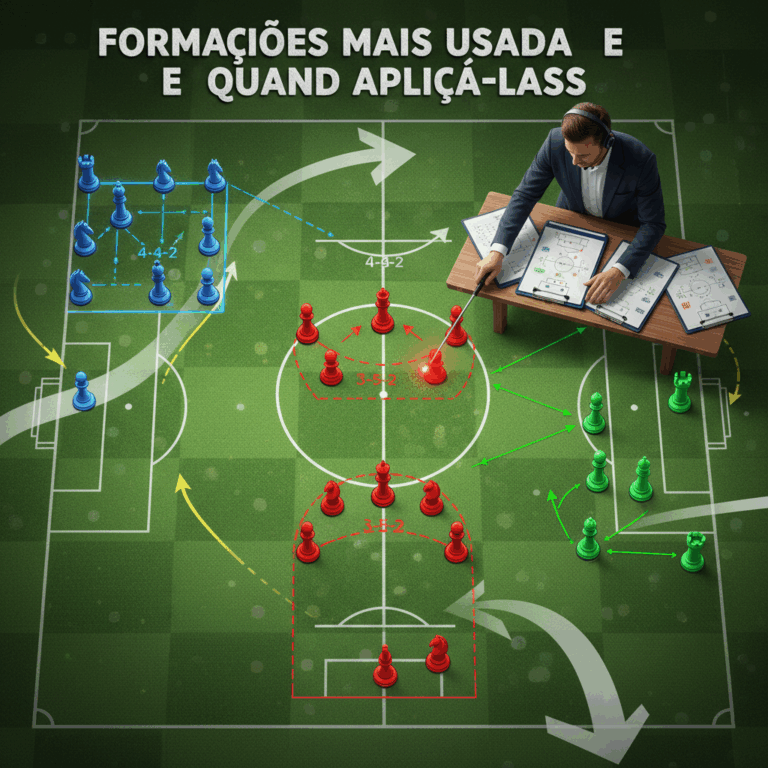
Tactical formations in professional football define the distribution of players on the field to optimize defensive and offensive functions. Your correct choice is key to the team's success.
These formations seek a balance between defensive solidity and offensive capacity, adapting to the team's style and objectives against different rivals and game situations.
4-4-2 formation: balance and defensive solidity
The 4-4-2 formation has four defenders, four midfielders and two forwards, seeking a balance between defense and dynamic attack. It is ideal for maintaining the structure without giving up quick offensives.
This tactic offers flexibility to strengthen defense and take advantage of counterattacks, allowing midfielders to connect with forwards effectively.
Its popularity lies in the solid combination it provides, ideal for teams that prioritize an organized defense with the possibility of attacking effectively without losing control of the midfield.
4-3-3 formation: attack and dominance of the midfield
The 4-3-3 is made up of four defenders, three midfielders and three forwards, focusing on offensive play and midfield control. Promotes high pressure and attack on the wings.
This formation is optimal for teams with fast wingers who seek to surpass their rival through speed and offensive breadth, dominating possession and generating many scoring options.
Postural balance allows him to reinforce the midfield and put pressure on the opponent, achieving superiority in key areas and opening spaces for the forwards.
Training in reduced football and its uses
In small football, tactical formations are adapted to teams with fewer players, seeking to maximize performance in limited spaces. The choice depends on the team's objective.
These formations allow roles to be clearly distributed, focusing on defense, attack or balance, to achieve effectiveness in short games or with rookie players.
2-1-1 formation: defensive priority
The 2-1-1 formation consists of two defenders, a midfielder and a forward. Their main advantage is to reinforce the defense to face superior rivals.
This structure provides security at the back, facilitating ball recovery and allowing quick transitions to attack with support from the midfielder.
It is ideal for teams that want to avoid conceding goals and take advantage of opponent errors through direct and effective counterattacks.
2-0-2 training: simplicity for novice teams
The 2-0-2 distributes two defenders and two forwards, without a defined midfield. Its simplicity makes it suitable for players with little experience in complex tactics.
This training prioritizes a basic structure that allows novices to understand offensive and defensive roles without complications, facilitating learning.
The team focuses on scoring and attacking with two forwards, while the defenders protect the goal in a compact and simple way.
1-1-2 formation: offensive strategy for comebacks
With a defender, a midfielder and two forwards, this formation is used when the team seeks to overcome results. Enhance the attack through numerical superiority forward.
Its design allows for greater offensive pressure, maintaining a midfielder who connects defense and attack to sustain possession and generate opportunities.
It is common in disadvantaged situations where the team must take risks to change the score with a coordinated and dynamic attack.
Historical military formations and their application
Historical military formations reflect the evolution of war strategy to maximize defense and attack according to weapons and the enemy. Its study reveals tactical principles applicable today.
These formations responded to terrain conditions, enemy types, and objectives, seeking control, mutual protection, and harnessing coordinated force to overcome violent conflicts.
Pikemen painting: defense against cavalry and resistance
The pikeman cadre is an infantry formation with soldiers armed with long pikes arranged in a compact square. It was essential for repelling heavy cavalry charges.
Its igruelist structure allowed it to cover all flanks, offering resistance and mutual protection. The formation also advanced, protecting the soldiers with firearms in the corners.
This scheme allows facing frontal and lateral attacks, favoring stability against attacks, ensuring that the cavalry could not break the defensive line easily.
Falange: frontal advance and mutual protection
The phalanx was a dense and deep formation, with soldiers in closed ranks carrying spears or long pikes. Their strength lay in the joint advance and cohesion of the group.
This tactic protected each combatant with the companion's shield, generating an impenetrable barrier and a unified front that could displace the enemy through constant pressure.
It was especially effective in open terrain where unity and order maintained control of the field, guaranteeing survival and coordinated offensive power.
Factors for choosing and adapting tactical training
The choice of tactical formations depends largely on the nature of the confrontation, the specific objective and the characteristics of the opponent. Adjusting these formations is essential to achieve maximum effectiveness.
From sport to military strategy, formations adapt quickly to respond to changing conditions, thus guaranteeing the optimization of collective and individual performance.
Considerations according to the nature and objectives of the confrontation
It is essential to analyze the situation of the game or battle, including factors such as the opponent's strength, the terrain and the available resources. These elements guide the choice of the most appropriate formation.
For example, one team may prefer a defensive formation against an offensive opponent, while another will look for an offensive disposition to take the initiative and control the pace of the matchup.
The clear definition of objectives also conditions training. Protecting an advantage requires conservative schemes, while seeking a comeback demands aggressive and dynamic structures.
Strategic adaptation to maximize effectiveness
Tactically adapting formations during the development of the confrontation is key to exploiting opportunities and neutralizing threats. Flexibility is one of the greatest strengths in strategy.
Coaches or commanders must read the context, modify positions and roles to respond to rapid changes, optimizing collective performance without losing cohesion or organization.
This adjustment capacity allows one's own resources to be integrated with the opponent's movements, maximizing tactical effectiveness and increasing the chances of success in any confrontation.