Historical and social context of derbies
The most intense derbies are not just football matches, but profound manifestations of historical and social antagonisms. These confrontations go beyond sport and reflect identity tensions.
In many cities, derbies symbolize political, religious and cultural divisions. Rivalry becomes an emotional expression that links the past with the present, making the game secondary.
The social context and history make each match have a special meaning for the fans, who see in the derby a way to reaffirm their identity and collective belonging.
Origin and symbolism of teams
Teams that participate in intense derbies often have origins linked to specific historical or social movements. Many times, these clubs represent groups with particular values or traditions.
For example, some clubs were born in periods marked by great conflicts, and their names or emblems reflect the identity and struggle of their communities. This gives the derby a deep symbolic load.
This symbolism strengthens the connection between fans and their teams, transforming each match into a confrontation that transcends sports to become a cultural and social clash.
Impact on regional identity
The most notable derbies powerfully influence the construction of regional identity. Sports rivalry serves to express cultural and social differences between nearby communities or even within the same city.
These matches foster the sense of belonging of the inhabitants, who recognize themselves through their colors and symbols. Passion for the team becomes a central element of local identity.
Furthermore, the intensity of the derby strengthens internal social cohesion and can reflect existing tensions, being a space where both rivalries and collective unity are projected.
Emblematic example: the eternal derby in Belgrade
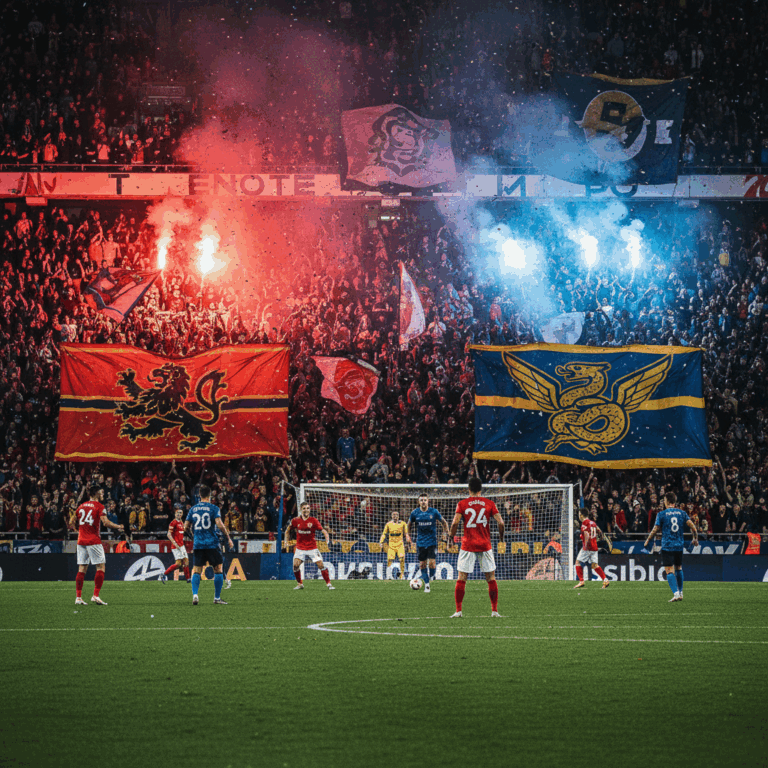
The eternal derby in Belgrade pits Red Star and Partizan against each other, two clubs separated by just 700 meters. This physical closeness intensifies a rivalry that goes beyond football.
Both teams were born in 1945 and symbolize important historical elements of the former Yugoslavia, reflecting in each party the collective memory and its social and political legacy.
This derby is a palpable reflection of the tensions and divisions that marked the history of the region, turning each match into an event full of symbolism and emotion.
Physical proximity and rivalry
The proximity of the stadiums increases rivalry and generates a unique atmosphere in Belgrade. Fans experience the competition not only on the field, but also in the surrounding streets and neighborhoods.
This proximity causes tension to grow before the game, with constant exchanges between fans, creating an atmosphere of permanent challenge throughout the year.
Thus, the dispute is not limited to ninety minutes, but extends to symbolic and territorial control within the city, intensifying the identity of each group.
Historical load and collective memories
Red Star and Partizan emerged as symbols in the communist period, representing ideologies and values linked to resistance and Yugoslav identity.
The parties evoke wounds and memories of social and political conflicts, where football becomes a channel to keep a shared and conflictive history alive.
This historical background gives special meaning to the derby, which is lived with a passion fueled by stories and experiences transmitted generation after generation.
Demonstration of identities in the city
Before and during the derby, the streets of Belgrade are dressed with symbols and colors of both teams, expressing a struggle of identities that marks urban life.
The confrontation becomes a public exhibition where the fans affirm their belonging and claim their place within the cultural diversity of the Serbian capital.
This phenomenon transcends sport, showing how football acts as a vehicle of social and cultural expression that shapes coexistence in the city.
Dynamics and preparation prior to the derby
Preparation for an intense derby begins days before the match, when tension and speculation invade the city. Every detail is analyzed and fans the fans' expectations.
This previous stage not only focuses on sports, but also includes symbolic and emotional confrontations between fans. Rivalry creates a unique and energetic environment.
Thus, the dynamics prior to the clash act as an invisible warm-up that increases fervor and passion, making the derby more than a simple football match.
Tension and speculation before the game
Days before the derby, social networks and media are filled with speculation about lineups, strategies and possible results. This tension grows and infects the population.
Fans argue passionately, anticipating each rival move. This generates a climate of anxious waiting where the match becomes the center of absolute attention, even outside the stadium.
Uncertainty and exaggerated rumors fuel the intensity, making the confrontation take on special meaning long before the game begins.
Territorial battles between fans
Before the initial whistle, territorial confrontations often occur between ultra groups. These battles symbolize the fight for control of urban space and the hegemony of your team.
The fans occupy the streets with flags, songs and symbols, trying to reaffirm their dominance and mark their presence in the city. This social clash precedes the sporting duel and generates great expectation.
These territorial disputes are not only provocations, but manifestations of collective identity that emphasize rivalry and emotional commitment to the club.
Elements that intensify derbies
The most intense derbies combine factors that go beyond sport, integrating a complex mix of politics, tradition and passion that elevates the matchup to an epic level.
This fusion creates scenarios where rivalry is perceived as essential to the identity of the communities, increasing the tension and emotional commitment of the fans.
Thus, each derby becomes a vibrant experience in which football is the vehicle to express much more than a simple result on the scoreboard.
Fusion of sport, politics and tradition
Sport serves as a symbolic battlefield where political and traditional aspects intersect, generating a rivalry that reflects deep social and historical divisions.
The most intense derbies usually represent clashes between ideologies or cultural identities, consolidating themselves as an emotional heritage that is perpetuated generation after generation.
This convergence makes the match transcend football, and each play is loaded with political and traditional meaning, amplifying passion and intensity.
Interesting fact
In many historic derbies, the team colors and anthems are based on the political or cultural legacy of the region, which strengthens the sense of belonging among fans.
These associations reinforce the commitment of fans, who see the team as an extension of their deeper social and political identity.
Epic and emotional expression of football
Football in the most intense derbies becomes an emotional epiphany, where each match channels collective feelings and tells stories of struggle and pride.
The energy of the fans and the tension on the field create a vibrant spectacle, which transcends sport to become an epic manifestation of rivalries.
For this reason, derbies not only impact momentarily but are recorded in social memory as episodes loaded with emotion and deep meaning.