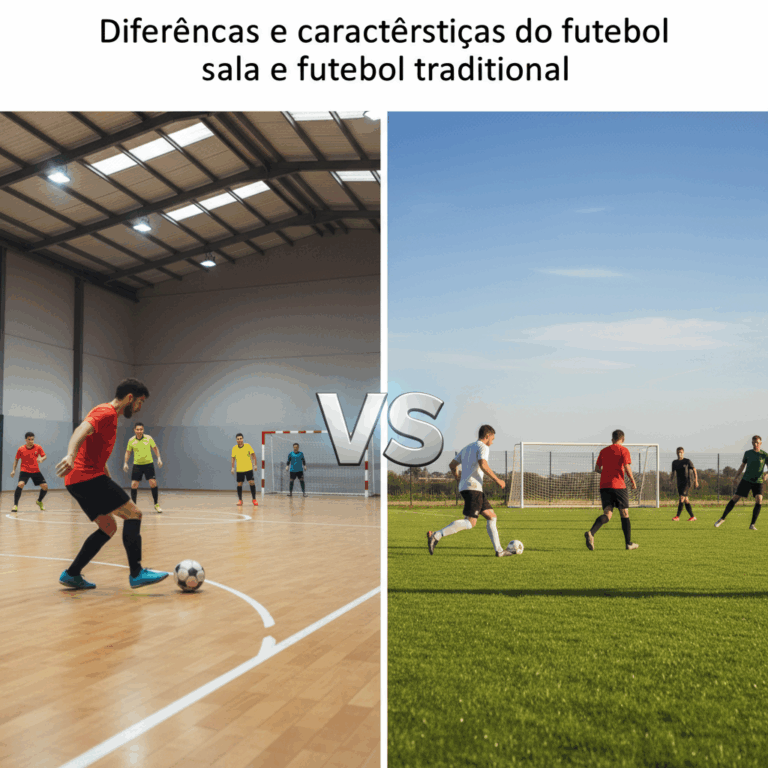
Differences in space and players
Futsal and traditional football are mainly distinguished by the playing space where they are played, which directly influences the dynamics and style of both sports.
These differences are also related to the number of players on each team, affecting the organization and type of strategy that predominate in each modality.
Knowing these particularities allows us to better understand the physical and technical demands of each version of football.
Dimensions and playing surface
Traditional soccer is played on a wide field, generally made of natural or artificial grass, outdoors, with large dimensions that favor movement and long-term strategy.
On the other hand, futsal is played in closed spaces, with smooth surfaces such as parquet or synthetic, and much smaller dimensions, which generates a faster and more intense game.
This difference in space affects everything from the type of ball control to the pace at which the match takes place in each modality.
Number of players per team
Traditional football involves 11 players per team, which implies greater tactical complexity and coordinated movements over a large field.
For its part, futsal has teams of 5 players, including the goalkeeper, which requires greater closeness and speed in interaction between participants.
This reduction in the number of players enhances the importance of individual technique and quick decision making within the game.
Characteristics of the ball and duration of the match
The ball in futsal and traditional soccer presents key differences that affect the dynamics of the game and the technique required.
Furthermore, the duration of the matches and the temporal structure influence the pace and strategy of each modality.
These characteristics determine playing styles and demands that clearly distinguish both disciplines.
Size and behavior of the ball
In traditional football, a larger and bouncing ball is used, ideal for long passes and aerial plays.
On the other hand, the futsal ball is smaller and with less rebound, which requires greater control and technical precision.
These differences determine the type of skills that stand out: power and range in 11-a-side soccer versus touch and precision in futsal.
Playing time and temporal structure
Traditional football has 90-minute matches, divided into two 45-minute halves, with the clock running continuously.
In contrast, futsal lasts 40 minutes, in two 20-minute halves with a clock stopped when the ball leaves the game, generating an intense rhythm.
This temporal structure allows for a more dynamic and concentrated game in futsal, while 11-a-side football integrates more tactical and physical phases.
Substitutions and pace of play
In traditional football, substitutions are limited and must be made during breaks, affecting strategy and pace.
Futsal allows unlimited substitutions and in flight, which maintains a high pace and facilitates constant recovery.
This difference contributes to futsal maintaining a higher speed and a more fluid and physically demanding game.
Physical and technical requirements
Futsal and traditional soccer impose different physical and technical demands due to their unique formats and specific playing spaces.
These demands determine the type of preparation necessary to excel in each modality, highlighting particular aspects in condition and ability.
Understanding these differences helps to assess the qualities that each sport demands of its players, both physically and technically.
Physical condition and resistance
Traditional football requires great aerobic endurance due to the wide field and long duration of the match, involving continuous efforts.
On the other hand, futsal demands explosiveness and anaerobic resistance, with short runs, changes of direction and high intensity in small spaces.
This causes futsal players to need speed-focused physical preparation and quick recovery to maintain dynamics.
Meanwhile, traditional footballers develop a solid cardiovascular foundation to sustain the pace throughout the match.
Technical skills and decision making
Futsal requires precise and fast ball control, due to the smaller surface area and the constant proximity of opponents.
Speed in decision making is essential, since plays are resolved in a few touches, promoting creativity and mental agility.
On the other hand, traditional football allows more time to plan and execute plays, giving importance to the vision of the game and the collective strategy.
Both disciplines develop complementary technical skills that enrich the performance of players in their respective contexts.
Values and objectives of each modality
Futsal and traditional soccer promote essential values such as teamwork, discipline and respect, fundamental pillars in sports and personal development.
Each modality, however, emphasizes specific aspects that enrich the learning and experience of the players, adapting to their own characteristics and demands.
Understanding these objectives is key to making the most of the advantages that each version of football offers.
Promotion of teamwork and discipline
Both modalities value the joint work and discipline, promoting cooperation and respect between colleagues and rivals.
In traditional football, tactical coordination between numerous players on a wide field requires strong communication and group organization.
For its part, futsal promotes speed and precision in decision-making, integrating discipline and commitment in small spaces where every action counts.
This approach strengthens team cohesion and fosters positive, fundamental sporting attitudes in and out of the game.
Technical development for young players
Futsal is especially valued for its ability to enhance technical skills in young players due to their dynamic and demanding environment.
Small space and the ball with less rebound require precise control, quick touches and good ball handling, bases for solid technical development.
Many coaches use futsal as a complement to improve technique and agility before applying these skills in traditional soccer.