Origins of volleyball
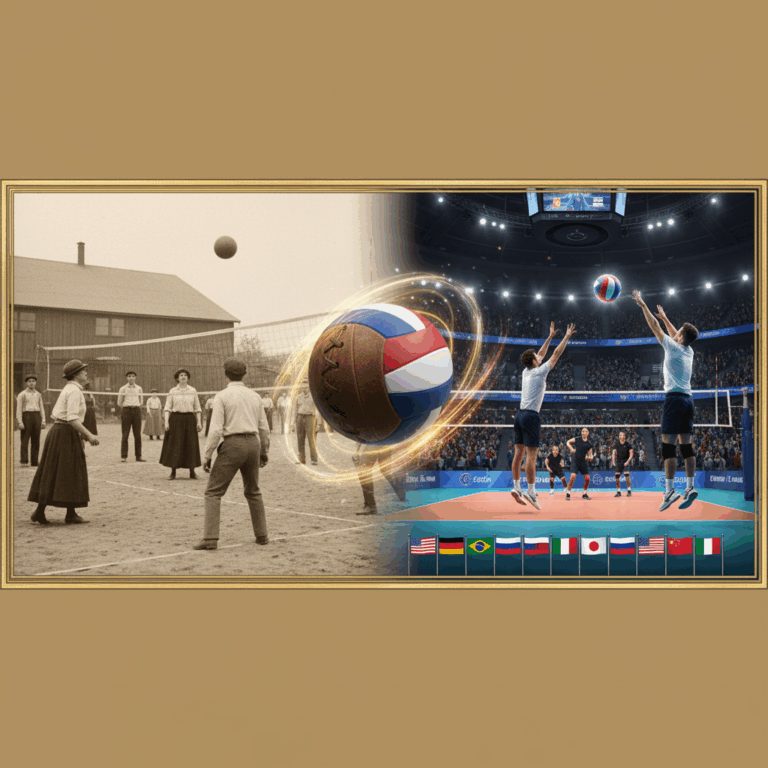
Volleyball was created in 1895 by William G. Morgan, director of Physical Education at the Youth Christian Association in Massachusetts, USA Morgan was looking for a collective sport less violent than basketball.
Originally called “mintonette”, the game was designed to be safe and accessible, with equipment separated by a net to reduce physical contact, ideal for indoor practice during the winter and for all ages.
Creation by William G. Morgan in 1895
William G. Morgan, inspired by basketball, devised a sport that emphasized skill and control without sudden contact. This is how volleyball was born, with basic rules to promote safety and fun.
The main objective was to allow physical exercise adapted to various ages, with a focus on cooperation and fair play, attributes that quickly attracted educational and social institutions.
First characteristics and objective of the sport
Volleyball was established with a net that divided two teams, minimizing physical contact and the risk of injury, making it suitable for closed environments and to maintain the player's health.
Furthermore, sport required less resistance than other games, favoring its practice among young people and adults, promoting teamwork and fun within a controlled and safe environment.
Evolution and global diffusion
Volleyball experimented important changes in rules and equipment to improve the dynamism and competitiveness of the game worldwide.
These modifications contributed to standardizing the sport, facilitating its practice in different countries and the development of international championships.
Changes in rules and equipment
They were standardized dimension of the court and the type of ball, adjusting its size and weight for greater control and precision in the game.
The maximum number of players per team was defined, and the rotation system was incorporated, which added tactical strategies during the match.
These changes made volleyball more dynamic and allowed the development of specialized techniques that enriched the sport.
Geographic expansion and first championships
Since 1900, volleyball spread rapidly around the world, starting in Canada and then reaching Asia and Europe after World War I.
American soldiers were key in spreading the game to other continents, transforming it into a popular and organized activity.
In Eastern Europe, sport gained special relevance and began to be celebrated national championships, like the first tournament in the Soviet Union in 1933.
Foundation of the FIVB and international standardization
In 1947, the creation of the International Volleyball Federation (FIVB) in Paris he was key to unifying rules and promoting the global practice of volleyball.
The FIVB organized the first world championships and facilitated the adoption of technical innovations such as locking and modern tactical systems.
Thanks to this regulation, volleyball was able to consolidate and presented sustained growth that led it to be recognized globally.
Technical innovations and Olympic participation
Volleyball has experienced significant technical improvements since their creation, they have optimized the performance and spectacle of the sport.
It also achieved its international consolidation by being incorporated into the Olympic Games, an important milestone for its dissemination and competitiveness.
Development of game techniques and systems
European teams introduced innovations such as the blocking system, improving defense and counterattack strategically.
In addition, specialized techniques such as bagging and attacking from the rear emerged, increasing the tactical variety during matches.
Distribution systems, such as 5-1, allowed for a more complex organization, raising the technical and collaborative level of the game.
Incorporation into the Olympic Games
Volleyball debuted as an exhibition sport at the 1924 Games and was officially included in 1964, consolidating its international status.
Initially only men participated, and in 1976 the women's category was added, expanding the inclusion and global appeal of the sport.
Global presence and current events
Volleyball is a sport with presence in almost all countries from around the world, thanks to more than 200 federations affiliated with the FIVB, which regulate and promote its practice.
Its international prominence is reflected in participation in events such as the Olympic Games and world championships, which bring together the best athletes and strengthen the discipline.
Federations and international prominence
National volleyball federations play a fundamental role in promoting this sport, helping to develop talents and organizing competitions at regional and global levels.
The FIVB coordinates all of these federations and ensures the application of uniform rules to maintain the integrity of volleyball on all continents.
This institutional support has driven growth cycles and expanded the visibility of the game, which is now one of the disciplines with the greatest global reach.
World powers and popularity of volleyball
Countries such as Brazil, Russia, the United States, Japan and Italy are considered powers in volleyball, dominating international tournaments and contributing to technical evolution.
The popularity of volleyball has spread due to its accessibility and dynamic structure, achieving a large base of fans and practitioners from childhood to adulthood.
Furthermore, globalization has facilitated the exchange of techniques and styles between nations, further enriching the competitive level and spectacle that volleyball offers.