Composition and team building
Volleyball is a sport that requires one precise organization in teams. Each has six players on the court and up to six substitutes available for replacements.
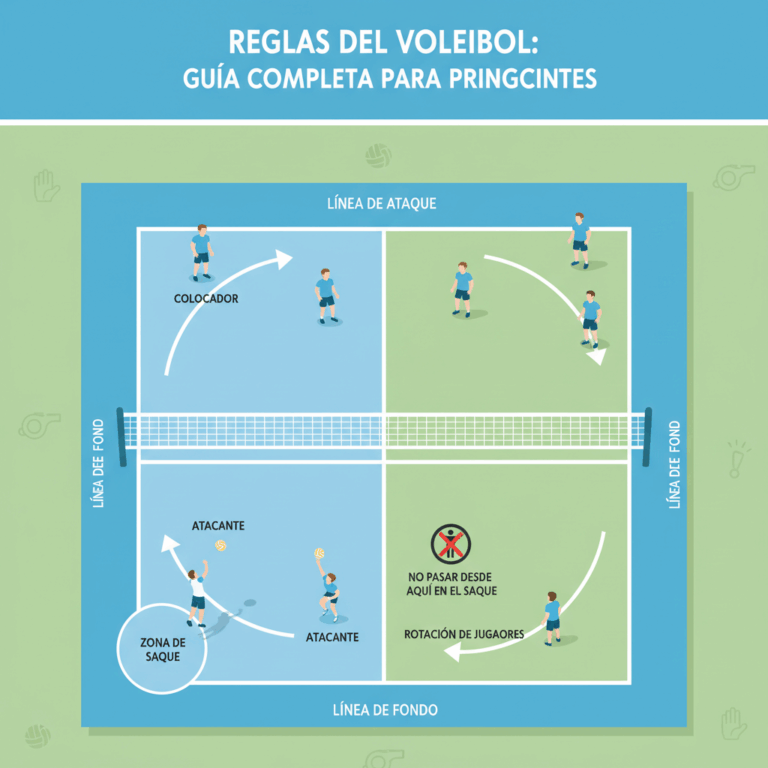
Players are strategically distributed in two lines: three at the front near the net and three in backfield defense, allowing a balance between attack and defense.
Number of players and positions on the field
Six players play simultaneously on each team, placed in specific positions to optimize gameplay. Three players are in front and three are behind, covering the entire court.
The front positions are left, center and right, while the rear positions occupy key defensive areas, allowing efficient ground coverage.
Only the six players on the court are actively involved, and the team can make rotations after each play to stay dynamic and competitive.
Role of the libero in the team
The libero is a defensive player with a different uniform, who cannot play at the front of the court. Its main objective is to improve the team's defense.
This player usually comes in to replace players on the back line and specializes in precise receptions and passes, facilitating the continuity of the game.
The libero cannot serve or attack over the net; His role is focused on keeping the ball in play and protecting the defense zone.
Game development and objectives
Volleyball is based on pass the ball over the net so that it touches the ground in the opposing field, preventing it from falling into its own. It is a dynamic and strategic game.
Each team can touch the ball a maximum of three times before sending it to the opposing side, which requires coordination and speed to overcome the rival defense.
Main objective of volleyball
The key purpose of volleyball is that the ball touch the ground of the opposite field, which allows you to score points and advance towards victory in each set.
Simultaneously, the team must prevent the ball from falling to its own side, maintaining a solid defense and controlling the pace of the game.
Thus, the balance between efficient attack and good defense defines development and success within the match.
Rules for hitting the ball
The ball should always be beaten, not held or thrown, respecting clean and fast contact to maintain the fluidity of the game.
Each team has up to three touches to send the ball to the opposing field, without the same player touching the ball twice in a row.
These rules ensure the agile pace and dynamics characteristic of volleyball.
Rotations and their importance
After winning the right to serve, the players must rotate your positions clockwise, ensuring that everyone participates in all areas of the court.
This rotation allows for balanced and strategic play, preventing a team from stagnating in fixed formations and facilitating tactical adaptations.
Failure to comply with rotations leads to the loss of serve and point for the opponent, penalizing errors in the organization.
Scoring system and sets
Volleyball is played in sets, where each one represents a fundamental part of deciding the winner of the match. The score in each set follows specific rules.
A team must reach a minimum of 25 points with at least two points difference to win a set, which guarantees a competitive and fair level.
Conditions to win a set
To win a set, a team must obtain at least 25 points and maintain a minimum two-point advantage over the opponent, avoiding close results.
If both teams reach a score of 24 equal, the set continues until one of them gains two consecutive points.
This rule promotes excitement and balance, lengthening the set until a clear difference is achieved, guaranteeing a fair ending.
Structure of the sets in an official match
An official volleyball match consists of a maximum of five sets, and the team that manages to win three of these sets first wins.
The first four sets are played with 25 points, but if a fifth set is necessary, it is played with 15 points, maintaining the difference of two.
These conditions allow teams opportunities to recover and keep the game intense until the end.
Fouls, serve and basic rules
In volleyball, the common faults they alter the development of the game and become important in defining points. Recognizing them allows you to play with greater strategy and respect.
The serve is the beginning of each play and must be carried out in accordance with the rules to guarantee a fair match. In addition, there are basic rules that regulate behavior and dynamics on the field.
Common faults and consequences
Among the most frequent fouls are: touching the net during the game, invading the opposing field and making two consecutive touches by the same player.
It is also considered a foul to keep the ball longer than allowed or throw it instead of hitting it, actions that result in the loss of the point for the offending team.
When the ball leaves the playing area or touches external objects, the point is awarded to the opposing team, favoring a fair and orderly game.
Rules of serving and behavior on the court
The serve must be taken from behind the baseline, and the ball must pass the net without touching it to be valid; Any error grants the point to the rival team.
Players must respect their position according to rotation during the serve, but can move freely once the play has started, maintaining strategy and mobility.
Furthermore, only the captain can communicate with the referees, ensuring disciplined and orderly control on the court during the match.