Fundamental serve techniques in volleyball
The serve is the crucial action that starts each point in volleyball. Its correct execution makes the difference between controlling the pace of the game or giving up the advantage to the rival.
To achieve an effective serve, it is vital to understand its types and the function each one plays. This helps adapt the technique according to the strategy and situation of the match.
Coordination, posture and precision are essential elements for the serve to be an offensive tool that makes rival reception difficult and generates point opportunities.
Types of serve and their purpose
There are several types of serve in volleyball, including low, high, floating and jumping serve. Each has specific characteristics that affect ball control and difficulty for the opposing team.
The low serve is traditional and easy to execute, ideal for beginners. The high, floating serve is used to make receiving difficult and cause errors in opposing defense.
On the other hand, the jump serve combines power and speed, functioning as an attack that can finish the point directly if necessary and strong.
Execute an effective serve
An effective serve requires a stable posture, with firm feet and a balanced body to maximize the precision and strength of the blow. Coordination in movement is essential.
In addition, control of the ball when throwing it and adequate contact at the optimal point allow you to direct and give the desired speed to the serve. Repeatedly practicing these aspects improves performance.
By mastering these elements, the type of serve can be varied depending on the strategy, thus achieving a positive impact on the dynamics of the match.
Reception to control the game
Reception is essential to maintain control of the game in volleyball. It allows you to prepare the next play, facilitating an effective and coordinated attack.
A well-executed reception ensures that the team keeps the ball in play, preventing the opponent from easily scoring points. Precision and technique are key.
Furthermore, reception requires concentration and speed to react to aggressive serves or attacks, ensuring a fluid transition between defense and attack.
Reception technique with forearms
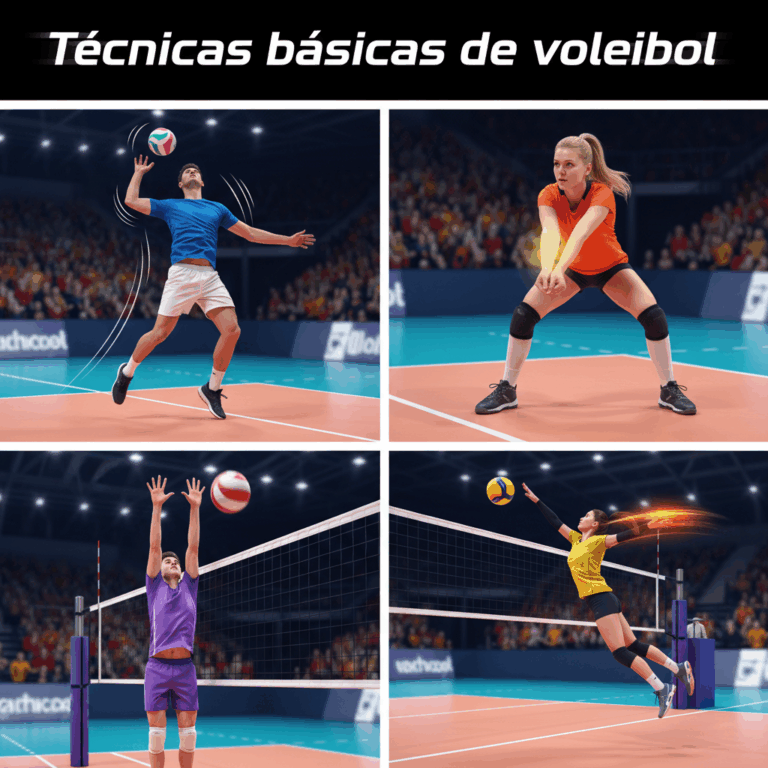
Reception with forearms is the most common way to control the ball after a serve or attack. It consists of bringing your extended arms together to form a solid platform.
To execute this technique, the knees must be kept bent and the arms firm, allowing the ball to be directed precisely towards the team setter.
Good contact with the bottom and center of the forearms helps control the trajectory of the ball, facilitating efficient play.
Importance of precision in reception
Precision in reception is essential for the team's success. An error can give the opponent an advantage or cause the point to be lost.
Receiving the ball accurately allows you to organize the attack, as it facilitates the appropriate pass and generates opportunities for effective shots.
Therefore, players must train to improve their control and anticipation, essential aspects for precise and constant reception.
Posture and balance during reception
Adopting a balanced posture is vital to react quickly and perform effective reception. Bending knees contributes to stability and mobility.
The weight should be distributed between both feet and the body slightly inclined forward, facilitating agile and controlled movements in any direction of the ball.
This posture allows you to keep the center of gravity low, which helps avoid imbalances and errors during the game. Good balance improves reception quality.
Blocking: key defense in volleyball
Blocking is an essential defensive technique that seeks to stop or deflect the opposing team's attack on the net. Requires coordination and excellent synchronization.
Correct execution of the block can frustrate opponent finishing attempts, reducing their chances of scoring points and facilitating the counterattack.
To achieve efficient blocking, it is essential that players maintain proper posture and communicate constantly during the play.
Position and synchronization in the lock
Proper positioning involves being close to the net with your feet separated and slightly bent to allow for an explosive jump. The arms must always be prepared to block.
Timing is key: players must jump just as the attacker executes the shot, thus maximizing the chances of success in blocking.
Jumping time and accuracy depend on early reading of the opponent's movement, which requires concentration and in-game experience.
Collaboration and coordination in the blockade
Blocking is a collective effort. Players must communicate to adequately cover different angles of attack and avoid free spaces on the net.
Coordination ensures that the blockers position themselves correctly and act as a solid, compact block, making it difficult for the ball to pass.
In addition, this collaboration allows the defensive strategy to be adjusted in real time according to the opponent's type of attack and positions on the field.
Aspects of the attack and finish
Attack is the key offensive tool in volleyball, seeking to score points through precise and powerful blows over the net. Mastering this technique is essential for success.
The shot combines strength, coordination and reading of the game to overcome the opposing defense. Requires precise execution to convert the play into a point.
An effective attack depends not only on power, but also on strategy and control to adapt to the circumstances of each match.
Technique and strength in finishing
The shot requires an adequate body position, starting with an explosive jump that allows you to take advantage of the height to hit the ball with power.
The movement of the dominant arm has to be quick and coordinated, achieving firm contact at the top of the ball to maximize strength.
In addition, entry and drive are essential to generate enough energy, both to overcome the block and to make it difficult for the opponent to defend.
This technique is perfected with constant practice, developing physical strength and timing to achieve effective and precise blows.
Strategic objectives of the attack
The attack seeks to overcome the opposing block and place the ball in areas where the opposing team has difficulty defending.
A common strategy is to vary the direction and strength of the shot to surprise and destabilize the rival defense, generating clear scoring opportunities.
It is also important to read the opposing team's formation and select the type of attack that maximizes the chances of success on each play.