Main positions and their basic roles
In volleyball, each of the main positions plays a crucial role in the team's success. Knowing these basic roles is essential to understanding the dynamics of the game.
The six positions on the court specialize in offensive and defensive tasks that, combined, allow for balanced and efficient performance during matches.
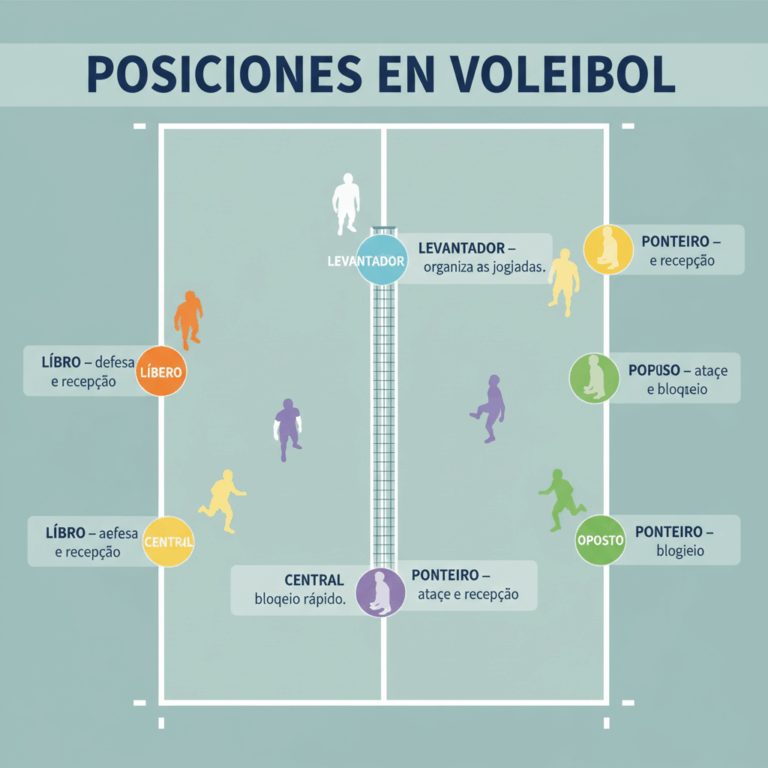
This space is dedicated to explaining two of the key positions: the setter, who leads the attack, and the center back, responsible for blocking and defending in the center.
Placer: leader and organizer of the attack
The setter is the brain of the team, in charge of distributing the ball precisely to facilitate attacks. Your second touch must be quick and accurate.
He requires quick thinking, leadership and vision to coordinate offensive plays, ensuring his teammates receive the ball in the best possible position.
Constant communication with the team is key for the setter to organize effective attacks and adapt to game situations.
Central: block and defense in the center
Located in the center of the net, the center specializes in blocking the opponent's attacks, thus protecting the crucial area from the net.
In addition to blocking, he participates in quick attacks, acting as a timely attacker who takes advantage of speed and height to surprise.
To fulfill his role, he needs good reading of the game, quick reflexes and anticipatory ability to neutralize opposing offensives.
Details of offensive positions
In volleyball, offensive positions are essential to generate points and maintain pressure on the opponent. Each one has special characteristics that enhance the attack.
These positions combine technical skills, power and versatility to execute shots, receptions and attacks that define the pace of the team's offensive game.
In this section, two essential roles stand out: the receiver-attack and the opposite, both key pieces in the offensive scheme.
Receiver-Attack: versatility and power at the tip
The receiver-attack plays in the left zone and combines offensive and defensive functions, being vital for the team's stability in both aspects.
He is a versatile player who receives serves and makes powerful shots from the top, requiring great jumping ability and control of the ball.
His ability to switch between defense and attack makes him an invaluable resource for maintaining the continuity and effectiveness of the game.
This position demands physical and mental resistance, because you must respond quickly in changing situations during the match.
Opposite: main attacker from the right
The opposite is the strong attacker on the right left side, in charge of making decisive shots and attacking in complex situations.
His role is not limited to attacking; He also contributes to the block to neutralize the main attacker of the opposing team.
It requires power, aggressiveness and precision to dominate attacks from the first and second lines, making this position a constant threat.
Specialized defensive roles
In volleyball, defensive roles are vital to avoid opponent points and maintain team stability. These players specialize in reception and rear defense.
The libero stands out among them for his unique ability, focusing exclusively on defense to ensure continuity of play with precise and effective passes.
This section explores the role of the libero, his importance in defense and how he influences the team's overall performance.
Libero: specialist in reception and rear defense
The libero is a specialist player located in the rear area, dedicated exclusively to defense and reception, and cannot attack or block at the net.
His greatest skill is anticipation and agility to recover low and difficult balls, ensuring that the team maintains possession during the game.
Furthermore, the libero must excel in the precision of his passes, facilitating the organization of attacks from defensive positions.
He is often one of the fastest and best-reading players in the game, allowing defense to be organized effectively and confidently.
Additional functions and rotation on the court
In volleyball, the role of zone defender is key to reinforcing the defense without affecting the offensive dynamics. Their specialization allows them to cover vulnerable areas of the team.
On-court rotation ensures that all players fulfill their specific functions from different positions, maintaining a continuous tactical balance.
Understanding these functions and rotation is essential to evaluating how a team maintains its performance during the game without losing its structure.
Zone defender: tactical defensive support
The zone defender reinforces the defense at key moments, providing reception support and rear cover without participating in the attack or blocking.
This player usually replaces teammates with less defensive ability, increasing security in reception and facilitating the offensive transition.
Their tactical role is important in maintaining defensive stability, especially when the team faces powerful or adverse situational attacks.
Rotation and maintenance of functions in the game
Clockwise rotation after winning the serve allows players to position themselves in different zones but maintain their specific roles.
Although the position on the court changes, each player continues to fulfill their main function, adapting so as not to affect collective performance.
This system ensures fluidity and order in the game, optimizing both defense and attack throughout the entire match.