Differences in team structure
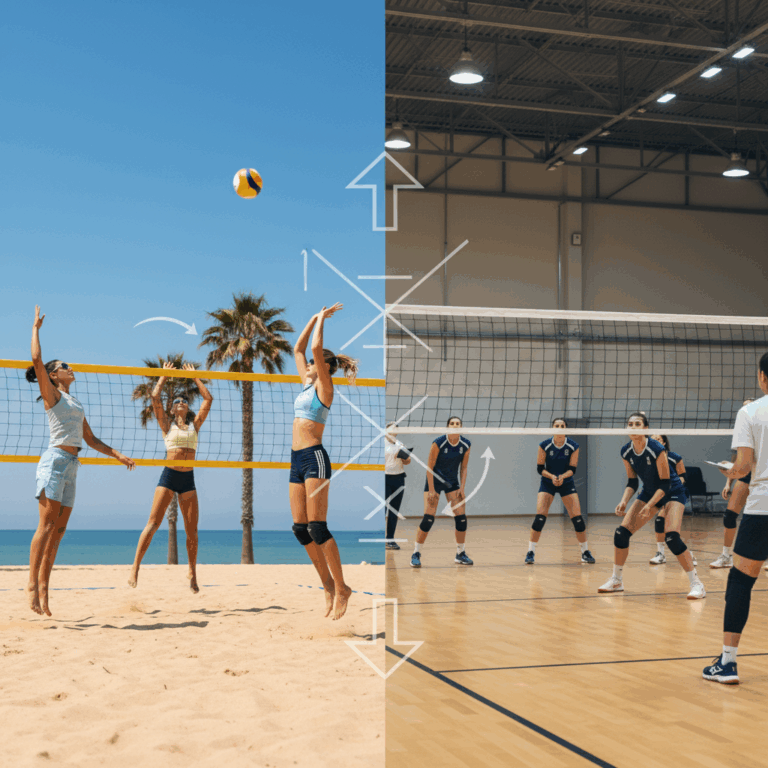
Indoor and beach volleyball present notable differences in the structure of their teams, which determine the style and dynamics of the game.
In the room, role specialization allows for complex tactics, while on the beach versatility and cooperation between two players are essential for performance.
These differences directly impact the strategy, technique and physical demands of each modality.
Training and roles in indoor volleyball
Indoor volleyball is played with six players per team, each with a specific role, such as point guard, attacker or libero. This training favors specialization in specific skills.
Players are organized to execute elaborate tactical systems, where rotations and coordinated work are key to success in attack and defense.
This structure allows for multiple blocks and quick attacks, taking advantage of the hard surface and the greater number of players to diversify the game.
Composition and versatility in beach volleyball
In beach volleyball, teams consist of only two players, meaning both must master all facets of the game, from receiving to blocking.
This need for versatility forces versatility, since there are no substitutions or specialists, and each player must constantly adapt to multiple roles.
In addition, continuous communication and teamwork are essential to cover the space and make strategic decisions in a more demanding physical environment such as the arena.
Specific technical aspects of each modality
Techniques in indoor and beach volleyball differ markedly due to the conditions of the game and the number of players, affecting the precision and style of play.
While sala emphasizes specialization and quick passes, playa requires adaptations to the sand, limiting power and privileging strategic placement.
These technical differences are reflected in the execution, where each modality requires the development of unique skills adjusted to their environment and pace of play.
Techniques and skills in indoor volleyball
In indoor volleyball, technique prioritizes passing precision, especially the top pass, which drives coordinated attacks between specialized players.
Movements include double or triple blocks and quick movements on the hard surface, with powerful jumps for effective shots and defenses.
Players focus on honing specific skills that allow them to execute complex tactical plays and offensive combinations with great effectiveness.
Technical adaptations in beach volleyball
On the beach, the presence of only two players requires comprehensive mastery of all techniques, from passing to defense, without rigid spécialisation.
Sand slows down movements and limits strength in jumps and attacks, so the technique adapts towards more controlled blows and precise placements.
Additionally, the rules restrict the use of certain techniques, such as finger passing in attack, which requires greater creativity and adaptability in each action.
Influence of the surface on the technique
The playing surface has a decisive impact on the technique: the hard floor facilitates speed and jumps, while the sand requires greater effort and reduces speed.
This factor forces us to modify movements, jumps and the way the ball is hit, prioritizing control and efficiency to compensate for physical difficulties.
Consequently, the beach technique is aimed at minimizing wear and maximizing effectiveness, while in the room constant power and dynamic precision are sought.
Predominant tactical strategies
Strategies in indoor and beach volleyball reflect differences in number of players, roles and environment. Elaborate systems predominate in the room.
On the beach, tactics are deeply based on communication and the use of free space, seeking efficiency in each movement.
Both modalities require adaptation, but their tactical approaches are clearly different and respond to their specific conditions.
Tactics and systems in indoor volleyball
Indoor volleyball uses complex tactical systems, where rotations and specialization allow for coordinated attacks and organized defenses.
Double and triple blocks are used, as well as coverages that require high synchronization between the six players to control each action.
Teams develop elaborate plays, combining feints and precise shots that take advantage of the group structure to gain an advantage.
This turns tactics into a collective game where anticipation and teamwork are key to success.
Tactics based on communication and space in beach volleyball
In beach volleyball, the tactic is based on constant communication between the two players, who must cover the entire space without outside help.
The attack always seeks free spaces on the field, using strategic positions rather than power to overcome rivals.
The absence of specialists requires full cooperation, with quick decisions and tactical adaptations depending on the game situation.
The opponent's reading and individual creativity make the difference, making the game a dynamic and flexible strategy.
Physical and environmental factors
Physical and environmental factors play a crucial role in players' performance in both modalities, affecting their resistance and strategies.
Sand and outdoors pose specific challenges in beach volleyball, while the controlled environment and hard surface characterize indoor volleyball.
These differences influence physical preparation, movement and the ability to adapt during the game.
Impact of the environment and physical effort on the beach
Beach volleyball is played outdoors, exposed to factors such as solar wind, temperature and humidity that affect player performance.
Sand makes movement difficult, increasing energy expenditure and forcing greater force in jumps and changes of direction to compensate for the soft surface.
This intensifies physical demand, requiring a high level of stamina and adaptability to maintain effectiveness during the match.
Movements and physical demands in indoor volleyball
In indoor volleyball, players move on a hard surface that facilitates quick movements and explosive jumps necessary for blocks and attacks.
Team dynamics and defined roles allow physical effort to be optimized, with alternating breaks and frequent changes that regulate fatigue.
The physical demand is high but different, focusing on speed, power and coordination to execute tactical actions during generally longer matches.