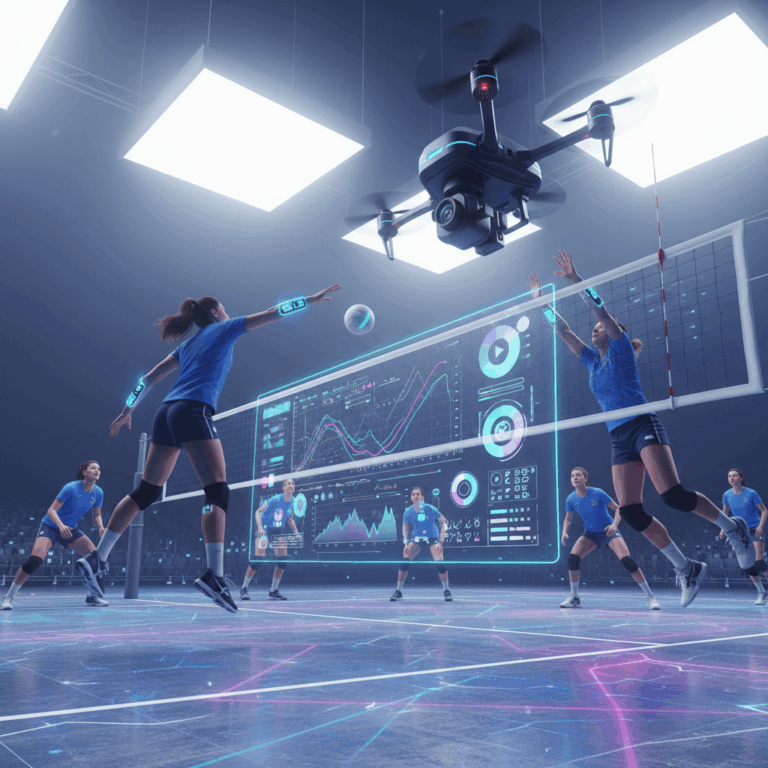
Video analysis in volleyball
Video analysis is a fundamental tool in modern volleyball to improve both the tactics and technique of the players. Using strategically placed cameras, matches and training sessions are recorded for later study.
This technology allows strengths and weaknesses to be identified through detailed review of actions, optimizing performance and facilitating immediate correction using specialized software.
Recording tools and techniques
High-definition cameras located on the court capture all essential movements during the game. These recordings are then processed with programs that allow for thorough and segmented analysis.
The use of multiple angles and the possibility of zooming facilitate the detailed evaluation of individual techniques and collective tactical movements, improving the focus of training.
Some systems incorporate real-time labeling functions that allow important actions to be marked for subsequent analysis, streamlining review and strategic planning.
Applications for tactical and technical improvement
Video analysis helps coaches and players correct technical errors by directly viewing and comparing executions, promoting constant evolution in the game.
It also serves to study the style and strategies of rivals, allowing the team's tactics to be adapted to maximize the chances of success in competitions.
Digital platforms offer customizable dashboards, visual metrics and reports that enhance decision making and the design of specific training plans.
Sensors for monitoring and optimization
Sensors in volleyball record accurate biomechanical data that helps improve individual and collective performance. These devices provide key information about movement and physical effort.
Constant monitoring using sensors allows you to control the training load, adjusting the intensity to prevent injuries and optimize the athlete's preparation. Its use has become essential.
Types of sensors used and functions
Accelerometers and gyroscopes are the most common sensors, measuring speed, acceleration and orientation of players during the match or training.
In addition, pressure and force sensors record impacts and load on the joints, facilitating detailed analysis of jumps, displacements and blows.
These devices can be portable and connect in real time with systems that analyze data, contributing to technical and physical evaluation during the activity.
Benefits in injury prevention and physical control
The use of sensors detects signs of fatigue or overload, helping to prevent common injuries by timely adjusting workloads and breaks.
Controlling physical parameters improves recovery and allows you to design personalized plans balancing effort and rest, prolonging the player's sports career and health.
Physical monitoring also helps identify incorrect movement patterns that can lead to injury, facilitating effective preventive interventions.
Integration with real-time analysis
The combination of sensors with real-time analysis software provides an immediate view of performance, allowing tactical adjustments during the match or training.
This integration facilitates automatic detection of key actions and physical states, optimizing quick and informed decision making to improve gameplay.
In addition, data connectivity and synchronization allow coaches and players to receive instant feedback, raising the competitive level and technical precision.
Use of statistics in sports performance
The use of statistics in volleyball allows a detailed analysis of individual and collective performance during matches. These metrics are obtained by carefully recording the key actions that occur in the game.
Statistical data helps identify patterns, trends and areas that require improvement, providing a solid foundation for tactical planning and specific exercises in training.
Registration and analysis of key actions
Statistics include the recording of actions such as serves, shots, blocks and receptions, allowing the effectiveness of each player and the team in general to be evaluated.
The quantitative analysis of these actions makes it easier to recognize strengths and weaknesses, generating accurate reports that support continuous improvement and strategic preparation.
In real time, these statistics can be viewed to dynamically adjust performance, analyzing match development and making decisions based on objective figures.
Application for tactical decisions
Statistical data is essential for tactical decision making, as it allows you to choose the best strategies based on demonstrated performance and the context of the game.
Statistical analysis provides clarity in the identification of key moments, favoring rapid adaptation to match and rival conditions through efficient adjustments.
Thus, coaches and players can optimize their resources and efforts to maximize effectiveness, improving competitiveness through informed and objective decisions.
Technological innovations and their impact
Technological innovations in volleyball have democratized access to advanced tools. Both amateurs and professionals can now benefit from analysis and training systems.
These technologies facilitate continuous improvement and learning, generating a positive impact at all levels of play, from initiation to high sports competition.
Tools accessible for all levels
Smart cameras and mobile applications allow you to easily record and analyze matches. These solutions are often intuitive, providing access to valuable data without the need for specialized training.
In addition, there are affordable software that includes functions for individual and collective monitoring, allowing coaches and players to plan personalized training sessions.
The availability of these tools helps expand the potential of the sport, encouraging inclusion and promoting technical and tactical evolution in youth and amateur categories.
Role of artificial intelligence in analysis
Artificial intelligence (AI) has revolutionized analytics in volleyball by processing large volumes of data to identify patterns and predict behaviors in the game.
Thanks to advanced algorithms, AI offers objective and automated evaluations, accelerating the analysis of video, statistics and movements captured by sensors.
This allows more precise decisions to be made in reduced times, improving tactical preparation, error detection and optimizing individual and collective performance.