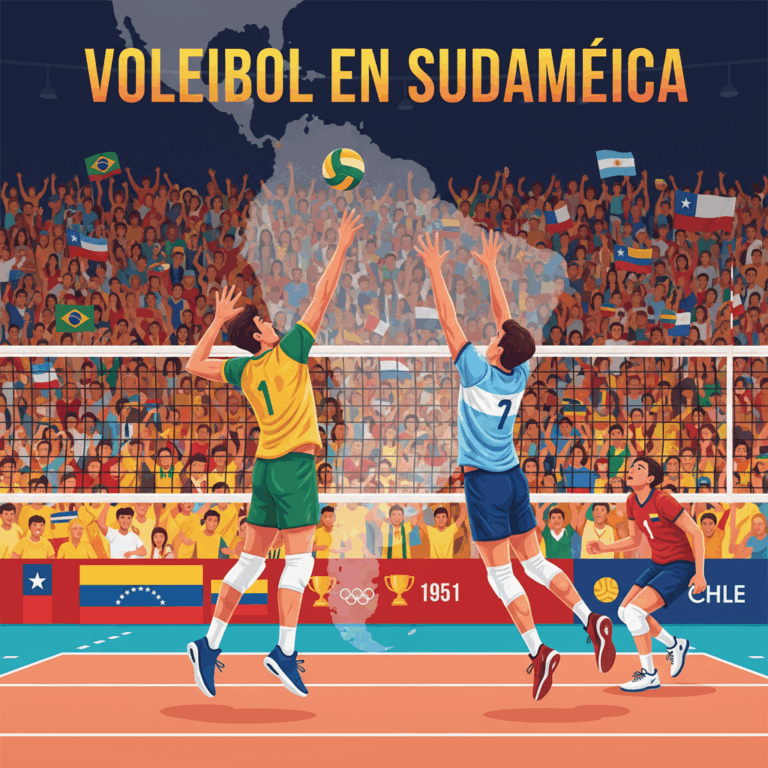
Origin and organization of volleyball in South America
The volleyball in South America it began to spread from the first decades of the 20th century. This sport came from American teachers, who influenced its rapid popularization.
Countries such as Peru, Argentina and Venezuela were the first to adopt volleyball, developing since then a competitive tradition marked by enthusiasm and organization.
Introduction of volleyball in South American countries
Volleyball was introduced to South America thanks to the American educational and sporting influence, which promoted its practice mainly in schools and social clubs.
This sport quickly consolidated in key countries such as Peru, Argentina and Venezuela, where communities accepted and promoted volleyball among youth and adults.
Its growth was driven by the simplicity of rules and access to open spaces, which facilitated its expansion throughout the region.
Foundation and role of the South American Volleyball Confederation (CSV)
In 1946 the South American Volleyball Confederation (CSV) to organize and promote volleyball throughout the region. This body regulates the discipline in South America.
The CSV was founded in Buenos Aires or Rio de Janeiro (According to different sources) and had Dr. Celio Negreiros de Barros, from Brazil, as its first president, marking a before and after in the structure of sport.
Since then, the confederation has been responsible for coordinating continental championships and promoting the competitive development and professionalization of volleyball in South America.
Competitions and evolution of South American teams
Since the 1950s, South American volleyball organized the first continental championships for both men and women, strengthening competition between nations.
Brazil and Argentina initially stood out, but over time other countries such as Peru and Venezuela also gained relevance in South American tournaments.
These events boosted the quality of regional volleyball and allowed the South American teams to be projected on international stages.
First men's and women's continental championships
In 1951, the first South American Volleyball Championship was held, defining the competitions for men's and women's teams. It was a milestone in the regional sports organization.
These championships served to establish important rivalries and to measure the competitive level of the countries participating in a formal tournament.
The periodic holding of these events allowed the tactical and technical growth of volleyball throughout the continent.
Historical domain of Brazil and Peru
Brazil established itself as the dominant power in South American volleyball, especially in the women's branch, accumulating 23 continental titles to date.
Peru represents another great historical force, with the women's team winning 12 championships and leaving an indelible mark on the region.
Both countries fostered the technical development and popularity of the sport thanks to strong structures and recurring results in international competitions.
Emergency of teams like Venezuela
In later years, teams such as the Venezuelan men's team began to stand out, showing significant growth compared to traditional teams.
Venezuela managed to consolidate itself as a relevant competitor, actively participating in continental championships and gaining recognition in the South American arena.
This emergence reflects the expansion and democratization of volleyball in South America, diversifying the regional competitive landscape.
International impact of South American volleyball
The south American volleyball he has left a significant mark on the international stage, achieving important achievements in various global competitions.
The region's teams have demonstrated their competitiveness, standing out especially in the Olympic Games, Pan American Games and world championships, which increases their prestige.
These successes reflect the technical and tactical quality developed in South America, positioning its teams among the best in the world.
Results in Olympic, Pan American and World Games
The South American teams, especially Brazil and Peru, have reached Olympic finals and medals in the Pan American Games, showing constant performance.
Brazil has been world champion on several occasions, consolidating its dominance in men's volleyball with outstanding titles and performances.
For its part, Peru has shone in the women's branch, ranking among the best in the world and leaving an indelible mark in international competitions.
Global recognition of outstanding teams
South American teams receive worldwide recognition for their dynamic style of play and refined technique, which makes them leaders in Latin America and the world.
Brazil is an iconic example, recognized as a powerhouse in men's and women's volleyball, celebrated for its championships and iconic players.
Furthermore, the visibility obtained in international tournaments contributes to the popularization and strengthening of volleyball throughout South America.
Development and popularization of beach volleyball
The beach volleyball in South America it has experienced notable growth, especially in Brazil, where it has achieved great popularity in recent decades.
This sport was born on Brazilian beaches and quickly expanded to other countries in the region, becoming a discipline with global recognition.
Importance of Brazil and emblematic beaches
Brazil is considered the epicenter of South American beach volleyball, with beaches such as Copacabana and Ipanema becoming iconic venues for practice and competition.
Brazilian sports culture has promoted the professionalization of beach volleyball, attracting thousands of fans and talents who have brought the competitive level to the world's elite.
The favorable climate and coastal character of the country facilitate constant practice, which contributes to the formation of international champions in this modality.
Popularity and global success of the discipline
Beach volleyball has become popular in South America thanks to its notable presence in international tournaments and the organization of events in countries on the continent.
South American teams, especially Brazilians, have achieved numerous world titles and Olympic medals, consolidating their global reputation in the sport.
The combination of visual appeal, accessibility and competitiveness ensures that beach volleyball continues to gain followers throughout the region and internationally.