Basic positions in basketball
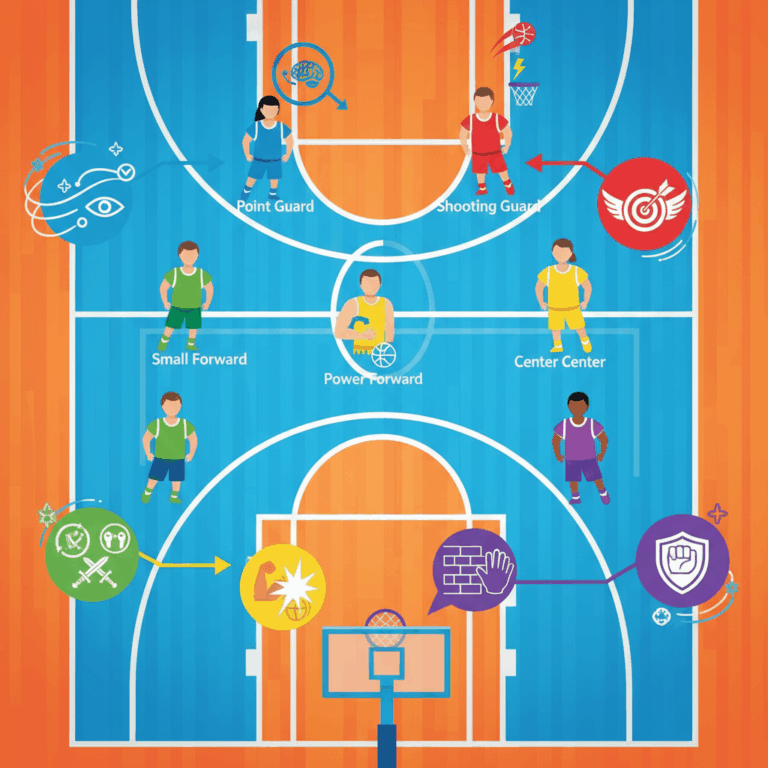
In basketball, there are five fundamental positions that define the role and strategy of each player on the team. Understanding these positions is key to appreciating the entire game.
Each position has specific characteristics that respond to both offensive and defensive functions, facilitating organization and effectiveness on the field. We start with the base and shooting guard positions.
The point guard: organizer and leader on the field
The point guard, or point guard, is him leader who organizes the game and distributes the ball. His speed and vision make him essential to guide the team during the game.
He is responsible for creating plays, coordinating the pace and making tactical decisions in real time. It also stands out for its ability to assists and robberies.
Acts as an extension of the coach on the court, showing ball handling skills, leadership and total control of the game. Without it, the team loses direction.
The guard: main scorer and defender
The escort is known for being the best shooter from the team, capable of scoring from the three-point line and penetrating the rival defense.
In addition, it plays an important role in defense, putting pressure on the opponent and helping to maintain defensive balance. His speed and agility are essential.
His precise aim and ability to adapt allow him to be a constant threat in attack, facilitating the movement of the ball and the generation of points.
Characteristics and intermediate roles
Intermediate positions in basketball, such as forward, power forward and center, combine physical and technical skills that provide balance and versatility to the team.
These players are essential both in defense and attack, as they allow them to adapt to different game situations with specific movements and strategies.
Their role helps connect the speed of the exteriors with the strength of the interiors, creating a cohesive and dynamic game.
The forward: versatile and key player in transition
The forward stands out for his great versatility, able to play near the rim and also in outside positions to shoot or assist.
His ability to adapt in offensive and defensive transition makes him a fundamental piece for him flow of the game.
Furthermore, his contribution on rebound and defense allows him to complement the team in multiple aspects of the game.
The power forward: physical strength and play in the low post
The power forward combines physical strength with technical ability to prevail in the low post and take advantage of contact situations.
His ability to score near the rim and capture rebounds provides important offensive and defensive support to the team.
Many players in this position also develop mid-range shots, increasing the tactical flexibility of the set.
Interesting fact about the power forward
Currently, the modern power forward not only plays in the low post, but can extend his shooting range, making rival defense difficult.
The center: physical presence and protector of the rim
The center is the tallest and strongest player, in charge of protecting the rim through blocks, blocks and capturing key rebounds.
His game takes place mainly in painting, where he finishes plays with dunks or movements in the low post.
Additionally, he plays a crucial role in creating space and facilitating plays for his teammates, strengthening the team's defense.
Specific functions of each position
Each position in basketball has a unique set of technical and tactical skills that define the style of play and contribution to the team.
Understanding these specific functions helps optimize strategy and maximize performance in both attack and defense.
Thus, each player contributes from their particular role to achieve an efficient and coordinated collective game.
Distinctive technical and tactical skills
The point guard stands out for his control of the ball, ability to pass and create opportunities, being the tactical brain of the team.
The guard excels in outside shooting and speed, combining scoring and defensive pressure to unbalance rivals.
The forward provides versatility with medium and long distance shots, as well as an active contribution in rebounds and defense.
The interiors, power forward and center, use their strength and physical presence to dominate the low post, secure rebounds and block shots.
Importance in defense and attack
In attack, each position fulfills critical roles: the point guard organizes, the guard scores, the forward provides mobility, and the interiors control the paint.
In defense, the point guard and guard put pressure on the rival, the forward helps with rebounds and cuts, while the centers protect the rim and stop penetrations.
The balance between these functions guarantees that the team maintains solidity in both areas, being able to adapt to different game situations.
Evolution and adaptation of positions in modern basketball
Today's basketball presents one constant evolution in traditional positions, adapting to the diversity of players' skills.
These adaptations allow classic positions to be make them more flexible, favoring a more dynamic and multifunctional game on the court.
However, despite this evolution, the traditional tactical structure remains the basis for maintaining the balance and effectiveness of the team.
Flexibility in roles according to individual skills
The positions are no longer rigid, since players develop roles according to their qualities, mixing offensive and defensive functions.
For example, a center can shoot from long distance or a point guard can play closer to the rim, multiplying the playing options.
This flexibility favors creativity, surprise and quick adaptation to changing match situations.
Maintenance of traditional tactical balance
Despite the flexibility, basketball maintains a tactical base that ensures the balance between defense and attack.
Traditional positions continue to guide team organization and distribution of responsibilities on the court.
This classic structure is essential for the team to function cohesively and efficiently during the game.