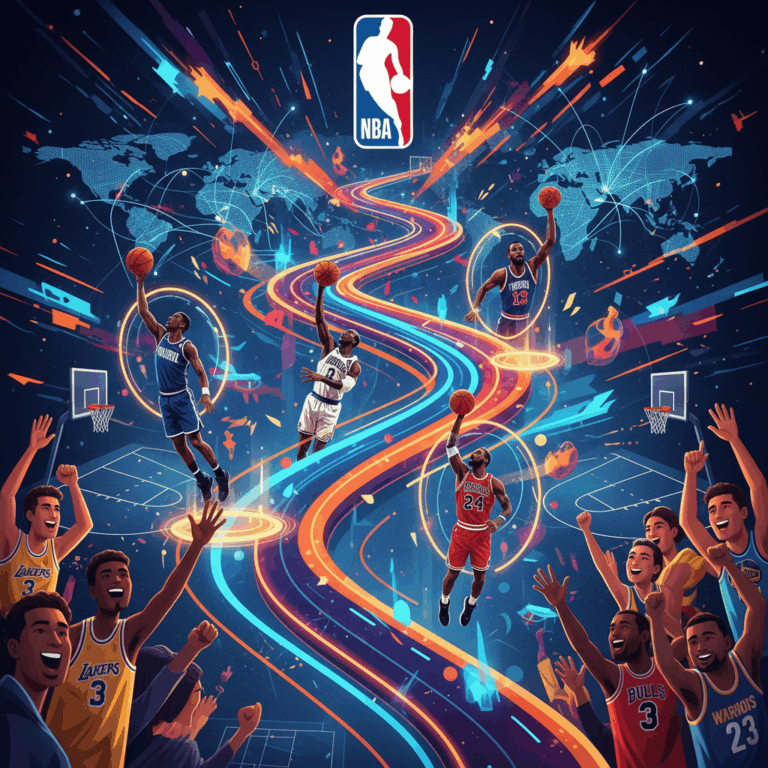
Foundation and early years of the NBA
The NBA, initially known as the Basketball Association of America (BAA), was founded in 1946 to maximize the use of large pavilions during the winter in the northeastern United States.
In 1949, the BAA merged with the National Basketball League (NBL), leading to the official creation of the National Basketball Association (NBA), the visible hallmark of the league we know today.
This period marked the beginning of a professional league that sought to consolidate itself in a competitive environment and with sustained growth in popularity and organization.
Origin and initial merger of the league
The NBA emerged after the merger between the BAA and the NBL in 1949, combining resources and teams to strengthen professional basketball in the United States with a more solid and competitive format.
Pavilion owners and entrepreneurs saw the opportunity to take advantage of winter with an indoor sport that could capture a growing and diversified audience.
This unification allowed the league to grow not only in number of franchises but also in quality and professionalism, laying the foundation for its future success.
Celtics dominance and early social integrations
During the 1950s and 1960s, the Boston Celtics led the NBA with eleven titles, thanks to figures such as Bill Russell and coach Red Auerbach, who defined the competitive style.
Additionally, around this time the MVP award was first presented in 1955 and the first African-American players were integrated, a key step in the fight for racial equality in the sport.
This period was crucial for the consolidation of basketball as a professional and socially inclusive sport in the United States, changing paradigms on and off the court.
Evolution and expansion in the second half of the 20th century
In the 1970s, the NBA faced intense competition with the American Basketball Association (ABA), recognized for its innovative and spectacular style that attracted many fans.
The merger of both leagues in 1976 not only united teams and players, but enriched the style of play and popularized elements such as the three-point shot, revolutionizing professional basketball.
This process was essential to consolidate the NBA as the dominant league in basketball and prepare it for its international expansion in the following decades.
Competition with the ABA and its merger
The ABA introduced innovations such as the tricolor ball and the three-point shot, which offered an attractive spectacle and differentiated its style from the traditional NBA.
The rivalry between both leagues led to battles for talent and audience, pushing the NBA to adapt and evolve to maintain its relevance.
In 1976, the formal merger incorporated ABA teams and stars, marking a milestone that allowed the NBA to consolidate its competitive and commercial power.
Figures such as Julius Erving (DEDr. J fren) symbolized this change, providing charisma and skills that influenced the popularization of basketball.
Internationalization in the 80s
The 1980s were key for the NBA, whose reach transcended the United States driven by the rivalry between Larry Bird and Magic Johnson, emblematic of the league.
This media competition captured global attention, placing the NBA at the center of world sport and sparking interest outside the country.
The television broadcasts and the narrative of its games strengthened the image of the NBA as a modern, exciting league with stars accessible to the world's public.
Global impact of Michael Jordan and the Dream Team
Michael Jordan transformed the NBA with his talent and charisma, becoming a global superstar and symbol of basketball during the 80s and 90s.
The creation of the “Dream Team” for the 1992 Barcelona Olympic Games marked a before and after, showing the elite of American basketball to the world.
This legendary team raised international interest in the NBA, expanding the influence of the sport and attracting future players from various countries.
Global consolidation in the 21st century
In the 21st century, the NBA established itself as a global league thanks to the promotion of stars who became international icons, such as Kobe Bryant and LeBron James.
The arrival of international players enriched the diversity of the league, bringing new styles of play and expanding the global fan and talent base.
This period marked a boom in basketball popularity, supported by innovations in communication and a strategic global marketing approach.
Promotion of stars and arrival of international players
The NBA opted to promote figures such as Shaquille O'Neal, Kobe Bryant and LeBron James, who transcended the sport and became international ambassadors.
Simultaneously, the league saw an increase in the addition of talent from all continents, which improved competitiveness and attracted new audiences.
Players like Dirk Nowitzki, Yao Ming and Giannis Antetokounmpo demonstrated that the NBA is a global stage that recognizes and enhances universal talent.
Use of media and events for expansion
The expansion of the NBA was enhanced with the strategic use of social networks, streaming and digital content, which brought the league closer to millions of viewers around the world.
Additionally, organizing matches and events in countries outside the United States strengthened connections with international fans and generated new business opportunities.
This strategy allowed the NBA to be broadcast in more than 200 countries, consolidating its position as the most influential and lucrative basketball league on the planet.
Global impact and current legacy of the NBA
The NBA has transcended its national league status to become a global phenomenon, influencing players and fans on every continent.
His legacy not only lies in sports competition, but also in the development of basketball as an accessible discipline practiced worldwide.
With a multi-million dollar audience, the NBA drives the growth of academies and training programs in diverse regions such as Asia, Africa and Oceania.
Global influence on basketball players and development
The increase in international players in the NBA reflects its impact on global basketball, showing talent from multiple countries at the highest level.
The league encourages the development of sport through academies and alliances that train young athletes around the world, expanding its reach.
This international integration has enriched the style of play and inspired new generations to adopt basketball as a high-performance discipline.
In addition, the NBA has promoted values of diversity and opportunity, consolidating itself as an engine for sporting and social growth.
Marked leadership and innovation in sports
The NBA stands out for its leadership in technological innovation, marketing and sports management that redefines the experience of fans and players alike.
It constantly incorporates new digital platforms, such as streaming and social networks, to expand its audience and improve global interaction.
Its ability to organize international events and adopt modern formats places the league as a benchmark in professional sports worldwide.
Interesting fact
The NBA is one of the few leagues to broadcast its games in more than 200 countries, a clear reflection of its reach and universal popularity.
This global phenomenon makes the NBA not only a tournament, but an important cultural engine that transcends basketball.