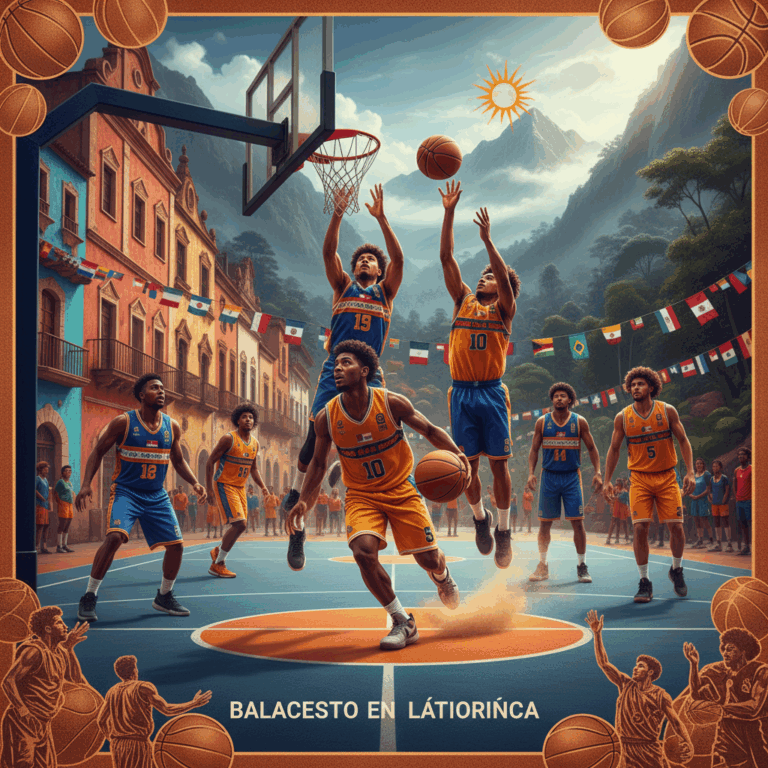
Origins and introduction of basketball in Latin America
Basketball arrived in Latin America at the end of the 19th century, leaving a deep mark on sports culture. Brazil was the first country to adopt it in 1896, thanks to foreign missionaries and educators.
From Brazil, basketball spread rapidly to Argentina, Uruguay and other countries on the continent, establishing the foundations for the popularity of the sport in the region.
This sport was initially consolidated in the school environment, where young people began to practice it and organize meetings, fostering an environment conducive to its future expansion.
First countries and initial diffusion
Brazil stood out as a pioneer in the introduction of basketball in Latin America, influenced by those who knew the game in the United States and brought it to the region.
Later, other South American countries such as Argentina and Uruguay adopted basketball, promoting its development during the first decades of the 20th century.
This initial dissemination facilitated the growth of sports practice and laid the foundations for the structuring of national leagues and international tournaments.
Role of educational institutions in popularization
Schools and universities played a fundamental role in the dissemination of basketball, integrating young people into this physical and competitive activity.
These institutions promoted team building and the organization of local tournaments, which allowed the sport to gain popularity on a sustained basis.
In addition, educational institutions offered an adequate environment for basketball to consolidate itself as a sporting discipline in the region.
Organization and key events in regional history
The first steps to structure basketball in Latin America were taken with the creation of associations and federations that organized and regulated the sport.
These organizations laid the foundations for formal championships and facilitated the participation of national teams in international tournaments.
The regional history of basketball is marked by milestones that drove its growth and visibility in the global sports sphere.
Creation of associations and federations
In 1915, the first legal basketball association in South America was founded in Uruguay, consolidating the organizational structure of this sport.
After this beginning, the Argentine Federation was established in 1921, strengthening the organization of basketball in the region.
These entities not only regulated the sport, but also promoted its development and team building in their respective countries.
First championships and their meaning
The first exclusive international basketball championship in the region was the South American Championship in the 1930s.
This tournament was a pioneer worldwide, as it brought together national teams, highlighting the importance of Latin American basketball.
More than a competition, the competition represented a fundamental boost for sports integration and healthy rivalry.
Participation in Pan American and World Games
With the first Pan American Games held in Argentina in 1951, Latin America showed its growing competitive level.
The 1950 World Championship in Buenos Aires consolidated Argentina as a regional power with an outstanding performance.
Brazil, for its part, reached the world summit by winning the FIBA World Cup in 1970 and winning Olympic medals, evidencing its leadership.
Cultural and social impact of basketball in the region
Basketball has transcended the sports field, becoming an engine of social integration in Latin America. It unites people of different ages and origins, strengthening regional culture.
This sport has fostered a sense of identity in many communities, especially in cities where teams represent more than the game: they reflect pride and cultural belonging.
The practice of basketball promotes values of teamwork, discipline and respect, essential aspects for social cohesion and the development of young people in the region.
Social integration and identity strengthening
Basketball facilitates coexistence and respect between different social groups, helping to overcome cultural barriers in Latin America. It is a tool for inclusion.
Additionally, sport builds collective identity by uniting communities around their local teams and traditions, cementing a sense of regional pride.
In urban and rural areas, basketball has become a symbol of equality and opportunity, with programs that promote the participation of children and young people in vulnerable situations.
Importance in cities and communities
Many Latin American cities consider basketball an essential part of their social life, with sports clubs that act as meeting and community development spaces.
These spaces generate support networks and strengthen the social fabric, helping to reduce problems such as violence and social exclusion.
In communities, basketball stimulates the training of local leaders and offers a healthy alternative for free time, positively impacting the quality of life.
Current talents and achievements
Latin American basketball has produced numerous players who shine on international stages, consolidating the region as a source of global talent.
Furthermore, the growth of women's basketball reflects an important evolution in the inclusion and development of sport in Latin America.
These advances highlight the continued commitment to sporting excellence and global recognition of regional basketball.
Outstanding players in the international arena
Players like Manu Ginobili and Luis Scola are emblematic examples of the Latin American talent that the NBA and major international leagues have achieved.
These athletes have not only stood out for their skill, but also for carrying the Latin American flag in important world competitions.
Its success drives new generations to dream of international races and raise the level of regional basketball.
Development and recognition of women's basketball
Women's basketball in Latin America has advanced significantly, highlighting the South American title won by Colombia in 1983 as a historic achievement.
The growth of women's leagues and the increase in institutional support have been key to raising the competitive level and visibility of the sport.
Currently, the presence of Latin American women's teams in international tournaments reflects greater recognition and social support.